In the rapidly evolving world of industrial automation, efficiency is measured not only by strength or flexibility but by speed and precision. Among the many robotic systems shaping modern manufacturing, Delta robots stand out as masters of rapid motion. Lightweight, agile, and remarkably accurate, these robots have revolutionized industries that demand high-speed pick-and-place operations. Though less visible to the public than humanoid robots or robotic arms in automotive plants, Delta robots quietly power some of the fastest production lines in the world.
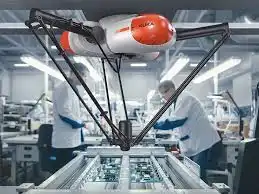
A Delta robot is a type of parallel robot composed of three lightweight arms connected to a common base. Unlike articulated robots that rely on serial joints arranged like a human arm, Delta robots use a parallel kinematic structure. This design allows the robot’s end-effector—the tool that interacts with objects—to move with extreme speed and precision within a dome-shaped workspace. Because the motors are mounted on the fixed base rather than on the moving arms, the arms remain light, reducing inertia and enabling rapid acceleration.
The Delta robot was invented in the early 1980s by Professor Reymond Clavel at the École Polytechnique Fédérale de Lausanne (EPFL) in Switzerland. Originally designed for high-speed packaging of lightweight objects, the concept quickly proved transformative. Its ability to perform thousands of pick-and-place actions per hour made it ideal for industries such as food processing, pharmaceuticals, and electronics manufacturing.
Technically, the Delta robot’s structure is its greatest advantage. By distributing mechanical forces across multiple parallel arms, it achieves both stability and speed. Servo motors control the angles of the arms, and sophisticated algorithms translate these movements into precise positioning of the end-effector. The result is a robot capable of smooth, synchronized motion at speeds far beyond those of traditional robotic arms.
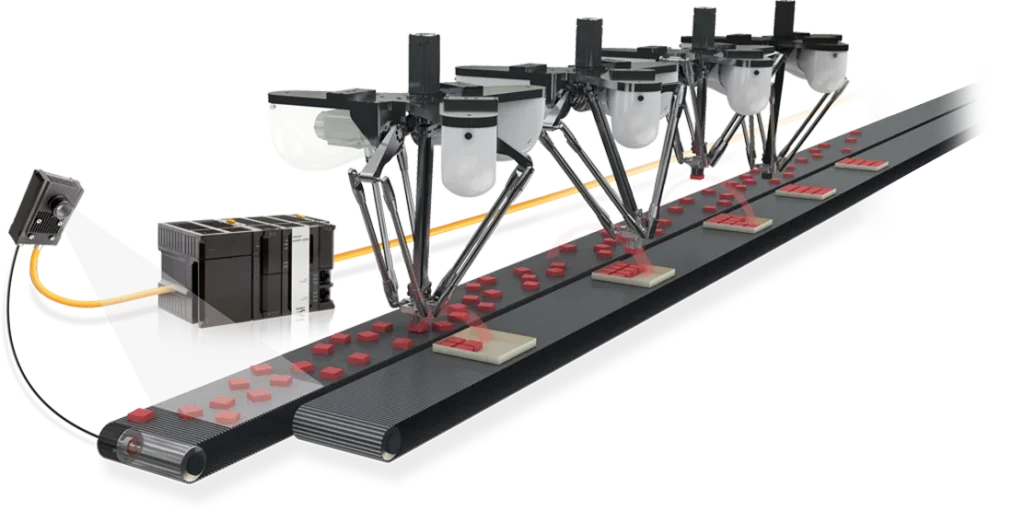
One of the primary applications of Delta robots is in packaging and sorting. On a conveyor belt moving at high speed, a Delta robot can detect, pick up, and place products with extraordinary accuracy. In food industries, they handle chocolates, baked goods, and small packaged items. In pharmaceutical production, they manage lightweight medical components under strict hygiene standards. Their precision reduces product damage and ensures uniform placement, which is essential in automated production lines.
However, Delta robots are not designed for heavy lifting. Their strength lies in handling lightweight objects quickly rather than manipulating large or complex structures. This specialization reflects an important principle in robotics: efficiency often comes from focused design rather than universal capability. By optimizing for speed and minimal moving mass, Delta robots excel in environments where rapid repetition is more valuable than brute force.
Beyond technical performance, Delta robots symbolize a shift in industrial priorities. As consumer demand for fast production and low-cost goods increases, manufacturers seek systems that maximize throughput without sacrificing accuracy. Delta robots meet this demand by combining mechanical innovation with advanced control software. Their integration with vision systems and artificial intelligence further enhances their capabilities, allowing them to recognize objects, adjust trajectories, and operate in dynamic environments.
From an economic perspective, Delta robots contribute to increased productivity and reduced operational costs. They minimize human involvement in repetitive tasks, lowering the risk of fatigue-related errors and workplace injuries. At the same time, their deployment requires skilled engineers and technicians, reinforcing the transition from manual labor to technical expertise in modern industries.