For centuries, human strength and mobility defined the limits of work, independence, and survival. When illness, injury, or aging weakened the body, those limits became permanent barriers. Today, robotic exoskeletons challenge that reality. By merging mechanical systems with human anatomy, exoskeleton technology is redefining rehabilitation, industrial labor, and the future of physical capability. What once belonged to science fiction is rapidly becoming a transformative medical and industrial solution.
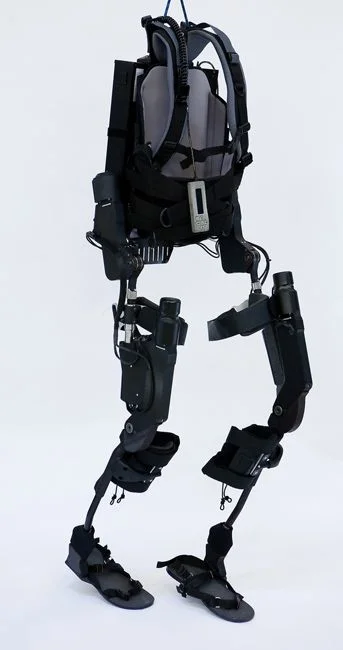
A robotic exoskeleton is a wearable mechanical structure designed to augment, assist, or restore human movement. Unlike traditional robots that operate independently, exoskeletons function as external frameworks worn around the body. They are equipped with motors, sensors, control systems, and lightweight structural materials that move in coordination with the wearer. Some are powered by electric actuators; others use passive mechanical support systems. In both cases, the goal is to enhance human strength or compensate for lost mobility.
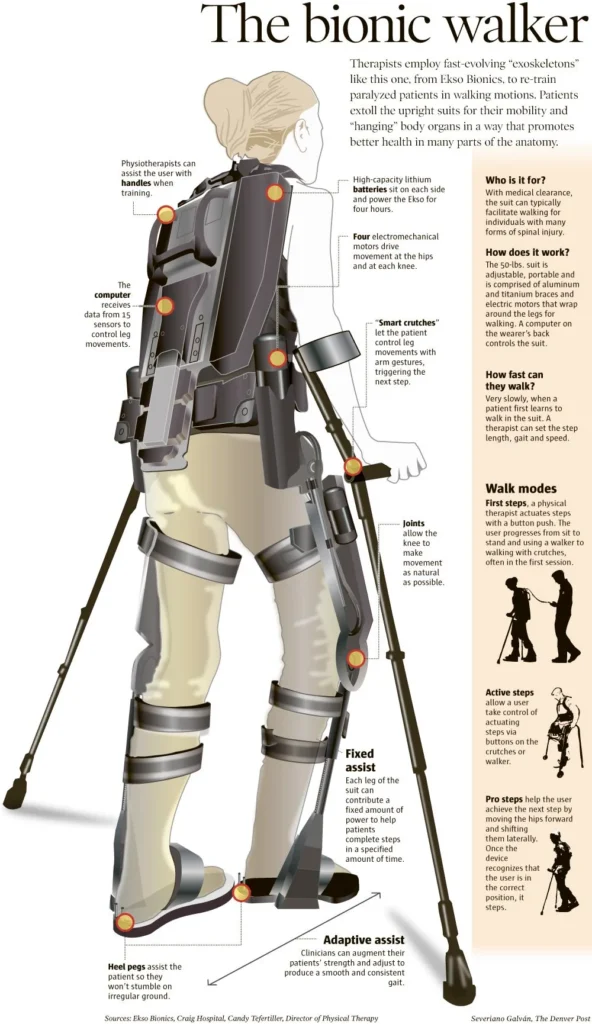
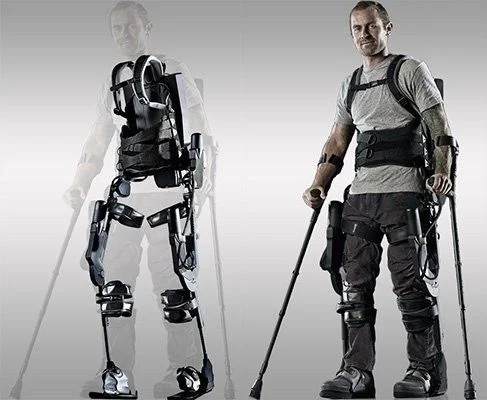
In medicine, robotic exoskeletons are particularly powerful tools for individuals who cannot walk due to spinal cord injuries, stroke, multiple sclerosis, or neuromuscular disorders. When neural pathways between the brain and muscles are damaged, voluntary movement becomes impossible. Exoskeletons provide external force to move the legs in a controlled walking pattern. Sensors detect shifts in body weight or upper-body motion, and onboard processors translate those signals into coordinated steps. Through repeated use in rehabilitation therapy, these devices not only assist walking but also stimulate circulation, prevent muscle atrophy, and encourage neural recovery through repetitive movement training.
One of the most remarkable aspects of medical exoskeletons is their ability to restore upright posture. For patients confined to wheelchairs, standing and walking—even with assistance—can significantly improve physical health and psychological well-being. The ability to look others at eye level and regain partial independence carries profound emotional impact. In this sense, robotic exoskeletons are not merely mechanical tools; they are instruments of dignity.
Beyond healthcare, exoskeleton technology extends into industrial and military applications. In factories and warehouses, workers often perform repetitive lifting tasks that strain muscles and joints. Industrial exoskeletons reduce fatigue by redistributing weight and supporting the lower back, shoulders, or legs. These systems do not replace workers but enhance endurance and reduce workplace injuries. Similarly, research into military exoskeletons aims to assist soldiers in carrying heavy equipment across long distances without excessive strain.
Technologically, robotic exoskeletons represent a convergence of biomechanics, robotics, and artificial intelligence. They rely on motion sensors, gyroscopes, pressure detectors, and advanced control algorithms to synchronize mechanical movement with human intention. Some systems integrate with neural interfaces or electromyography (EMG) sensors that detect muscle signals, enabling more intuitive control. Battery efficiency, lightweight materials such as carbon fiber, and compact motor design are critical engineering challenges that continue to shape development.
Despite their promise, robotic exoskeletons face limitations. High costs restrict accessibility, and prolonged use may require extensive training and supervision. Additionally, while exoskeletons assist movement, they do not yet fully repair underlying nerve damage. They are support systems rather than cures. Ethical considerations also arise regarding equitable access and potential disparities between those who can afford augmentation and those who cannot.
Yet the broader significance of robotic exoskeletons extends beyond individual mobility. They symbolize a philosophical shift in human–machine relationships. Rather than machines replacing humans, exoskeletons integrate with the human body, enhancing natural capability. They blur the boundary between biology and engineering, suggesting a future in which physical limitations can be mitigated through wearable technology.